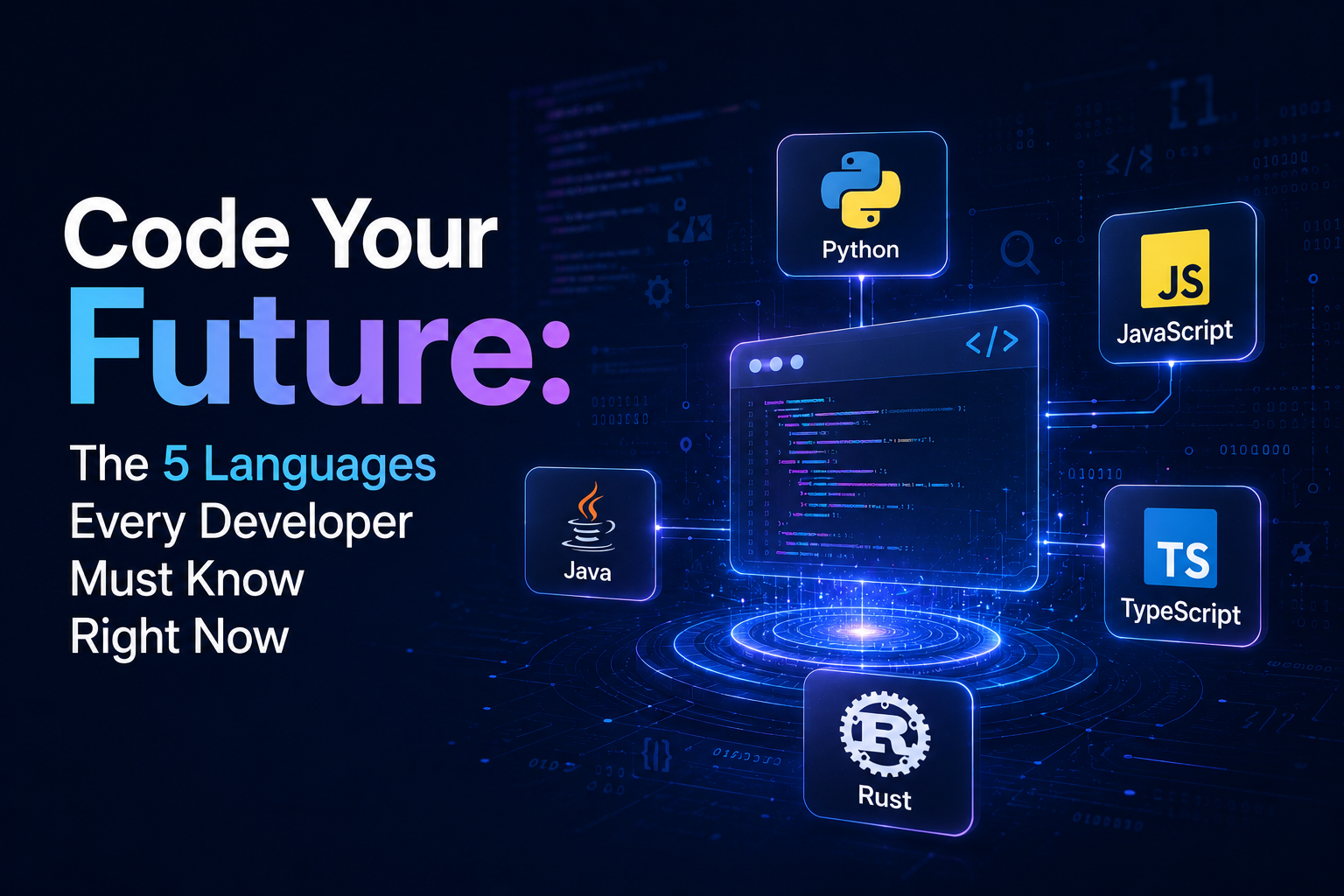
In a world where AI writes boilerplate and frameworks rise and fall like tides, choosing the right programming language can feel overwhelming. Yet beneath the noise, certain languages have emerged as pillars of the modern developer's toolkit — powering everything from AI research labs to billion-dollar mobile apps. Here are the five languages that dominate 2026 and why learning them is one of the smartest career moves you can make.
Python (The Swiss Army knife of modern computing)
Most Versatile
Python didn't just survive the AI revolution it caused it. With libraries like PyTorch, TensorFlow, and the entire scientific Python stack, it has become the lingua franca of machine learning, data science, and automation. Its clean, readable syntax lowers the barrier to entry without sacrificing power. From building neural networks to scripting DevOps pipelines, Python does it all with an almost unfair elegance. If you learn only one language, make it this one.
JavaScript (The language the internet runs on)
Most In-Demand
JavaScript remains the undisputed king of the web and with Node.js, it conquered the server too. The rise of React, Next.js, and edge computing has only deepened its dominance. Every website you interact with likely has JavaScript powering its interactivity. In 2026, full-stack JavaScript developers command premium salaries, and frameworks like Bun and Deno have reinvigorated the runtime landscape. Love it or hate it, JS is inescapable and truly mastering it is a superpower.
Rust (Speed and safety — finally together)
Fastest Growing
Rust has been StackOverflow's "most loved language" for nearly a decade straight and for good reason. It delivers C-level performance without the memory bugs that haunt low-level systems code. In an era of security breaches and performance-critical infrastructure, Rust is the language governments and cloud giants are betting on. The White House has even recommended its adoption. WebAssembly, operating systems, game engines, embedded systems Rust is quietly taking over the foundations of computing.
TypeScript (JavaScript, but with a safety net)
Enterprise Pick
TypeScript is what happens when JavaScript grows up. Microsoft's statically-typed superset of JS has been adopted by virtually every major tech company building large-scale applications. It catches bugs at compile time, makes codebases dramatically easier to maintain, and pairs beautifully with modern frameworks. In 2026, most serious frontend and backend JavaScript projects are TypeScript projects. Learning TypeScript isn't just smart at the enterprise level, it's practically mandatory.
Go (Golang) (Cloud-native simplicity at scale)
Cloud Native
Born at Google and designed for the cloud age, Go has become the backbone of modern infrastructure. Docker, Kubernetes, Terraform some of the most critical tools in a DevOps engineer's arsenal are written in Go. Its concurrency model is a revelation for building fast, scalable microservices, and its simplicity means teams can onboard quickly without sacrificing performance. As cloud-native architecture continues its takeover, Go developers are among the most sought-after engineers on the market.
The Bottom Line
You don't need to master all five overnight. Start with Python if you're drawn to AI and data, or JavaScript if the web excites you. Add TypeScript as your JavaScript skills mature. Then explore Go for backend systems or Rust for the thrill of low-level mastery. The best language is always the one you're actively building things with so pick one, write something real, and iterate from there. The future belongs to those who code it.