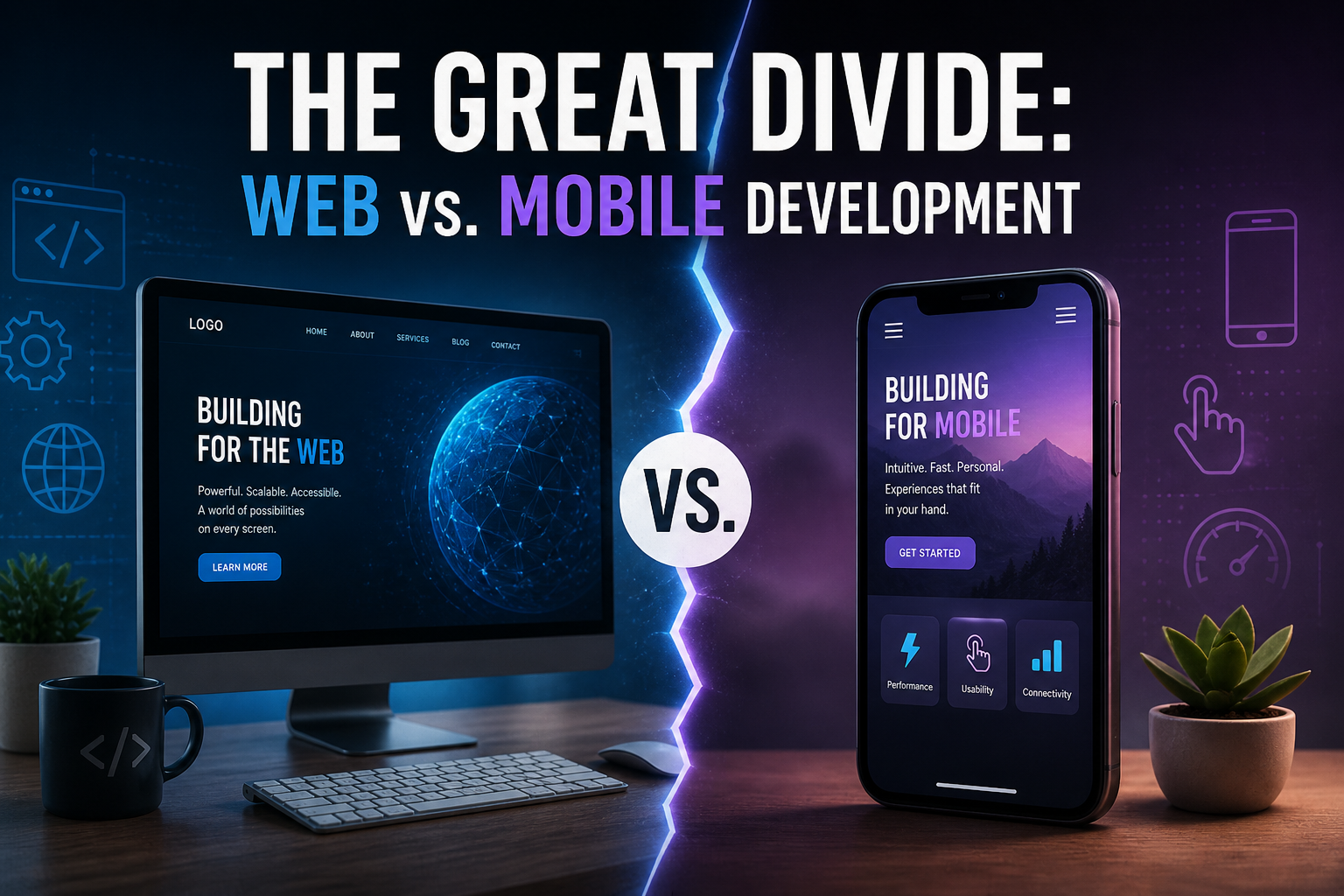
There is a war being waged quietly in every developer's mind. It is not fought with code or frameworks — it is fought with choices. Every day, thousands of new developers sit down and ask themselves the same question that has haunted the industry for over a decade: Do I build for the browser, or do I build for the pocket?
This is not a simple question. It is a philosophical one. Web development and mobile app development are not just two technical disciplines — they are two entirely different ways of thinking about software, about users, and about the future of digital experience. Each has its cult following, its champions, its evangelists. And each has very good reasons to claim supremacy.
The Web: Infinite Reach, Infinite Chaos
The web is democracy in digital form. Write a line of HTML, push it to a server, and in theory, anyone on Earth with a browser can see it. No app store approval. No platform gatekeeping. No $99 developer fee just to ship your work. The web is inherently open, inherently universal — and that is both its greatest strength and its most maddening complexity.
Web developers live at the intersection of design, engineering, and user psychology. They wrestle with browser compatibility (Chrome, Firefox, Safari — each with their own quirks and agenda), they optimize for search engines, they obsess over Core Web Vitals and page load times measured in milliseconds. A web developer's toolkit sprawls magnificently: HTML, CSS, JavaScript, and then a galaxy of frameworks — React, Vue, Svelte, Angular — each promising to solve the last framework's problems.
The web's power lies in its immediacy. Share a URL and you have an instant distribution channel. Update your code and every user sees the change — no version fragmentation, no "please update your app." For businesses, this is revolutionary. For developers, it means constant pressure to keep pace with an ecosystem that never stops evolving.
Mobile: The Computer in Every Pocket
Mobile app development is, at its core, an act of intimacy. You are not building something people visit — you are building something people carry. Something that buzzes in their pocket, sits on their home screen, and demands their attention at any moment. The smartphone is the most personal computing device ever created, and building for it requires a fundamentally different relationship with the user.
Native mobile developers — those who write in Swift for iOS or Kotlin for Android — work with a richness that the web has only recently begun to approximate. They have access to the gyroscope, the camera, the GPS, Face ID, the haptic engine. They can build experiences that feel physically real: swipes that respond to finger velocity, animations that obey physics engines, interfaces that load instantly because they live entirely on the device. This is not web development with extra steps — this is a different art form entirely.
But the mobile world comes with its own price. The App Store and Google Play are powerful gatekeepers. Your app can be rejected, removed, or subjected to a 30% tax on every transaction. Maintaining two separate codebases — one for iOS, one for Android — is expensive and exhausting. And unlike a website, a mobile app must be discovered, downloaded, and kept — each step representing user friction that most apps never survive.
The Career Question No One Answers Honestly
Here is what the tutorials will not tell you: your choice is not purely technical. It is economic. Web development jobs vastly outnumber mobile positions. The barrier to entry is lower — a browser's developer console is the world's most accessible coding classroom. Freelance web work is plentiful, the tooling is free, and the community is enormous. For someone entering the field, web development is the safer, faster path to employment.
Mobile development, particularly native iOS and Android, commands higher average salaries precisely because of its scarcity and difficulty. Companies that need a skilled Swift developer who understands performance profiling, memory management, and App Store submission will pay premium rates for it. The talent pool is smaller. The payoff can be larger.
The Future Is a False Binary
Progressive Web Apps (PWAs) have spent years promising to dissolve this distinction — and they have made real progress. Modern web apps can send push notifications, work offline, install to the home screen, and access device sensors. The gap is narrowing. But it has not closed. Native apps still outperform web apps in raw speed, hardware depth, and user trust. The promise of "write once, run everywhere" has been made and broken so many times that experienced developers greet it with knowing skepticism.
The most pragmatic view is this: web and mobile are not competitors — they are complements. The most successful digital products use both. A web presence for discovery, SEO, and broad access. A mobile app for engagement, retention, and deep user relationships. The question is never really "which one" — it is "which one first" and "with what resources."
So, Which Should You Choose?
If you are a developer at the crossroads, here is the honest answer: start with the web. The fundamentals — understanding how clients and servers communicate, how interfaces render, how state is managed — are universal. Master JavaScript and you hold a key that opens doors on both sides of the divide. React on the web becomes React Native on mobile. TypeScript knowledge transfers everywhere.
But do not mistake starting with the web for staying there forever. The developers who will define the next decade of software are the ones who can move fluidly between these worlds — who understand the browser's constraints and the mobile device's capabilities, who speak both languages, who know when a Progressive Web App is enough and when only a native experience will do.
The great divide between web and mobile is real. But the greatest developers have always known that the divide is a starting line, not a wall.