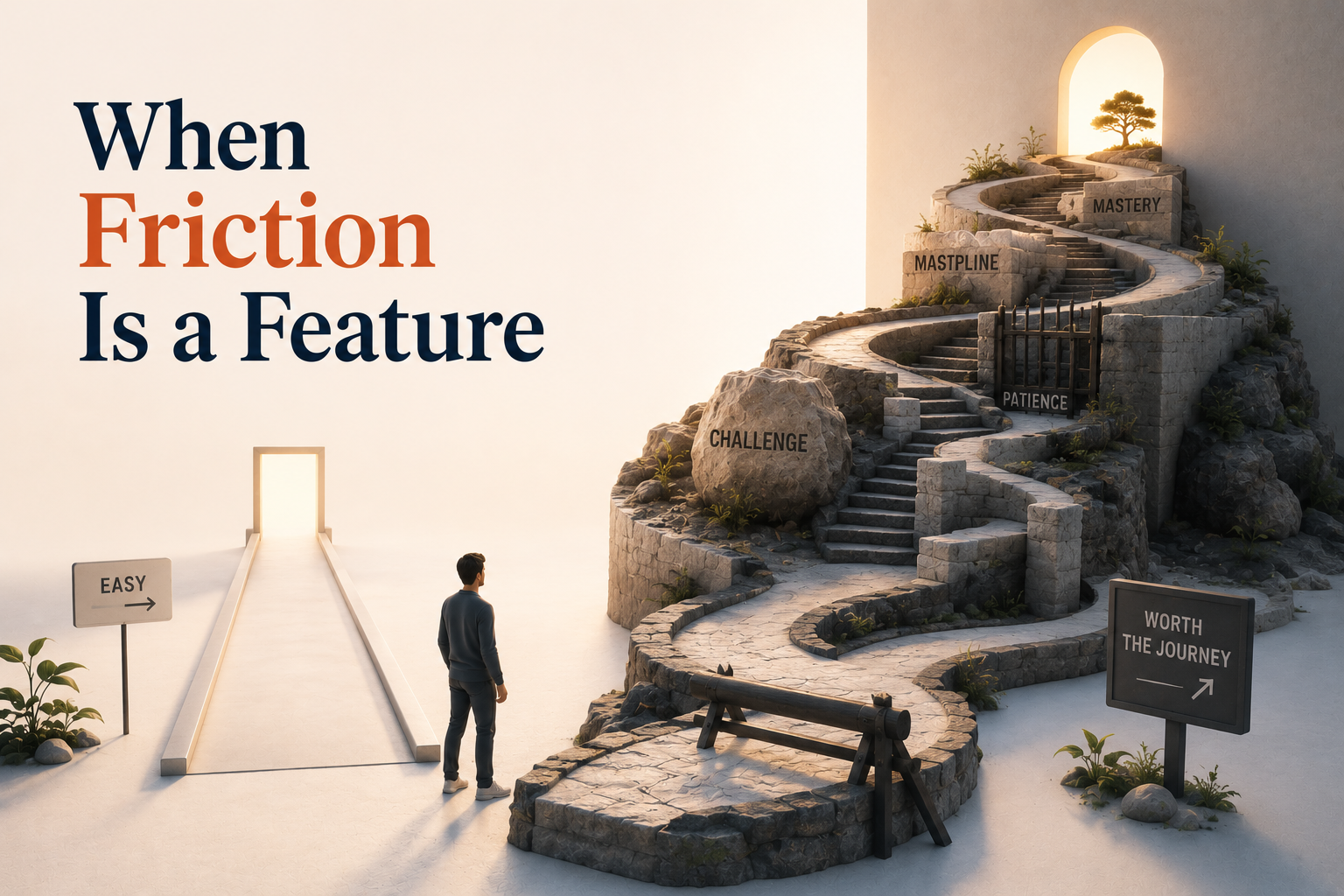
The first rule handed to every design student is seductive in its simplicity: reduce friction. Make the path shorter. Make the action easier. Make the next step so obvious that the user never has to stop and think. The entire discipline seems organized around this one idea, and for most of its history, the results have backed it up. Faster checkouts. Cleaner onboarding. Fewer abandoned carts.
But somewhere in the relentless optimization, something quietly went wrong. Interfaces became so frictionless that users stopped noticing what they were agreeing to. Purchases happened before intent had fully formed. Subscriptions auto-renewed before anyone remembered signing up. Social feeds scrolled forever because there was no natural stopping point, no moment that invited reflection. The friction had been so completely removed that human judgment went with it.
This is the paradox that serious UX practitioners are now grappling with: the goal was never to eliminate friction. It was to eliminate the right friction. And understanding the difference between the two is one of the most consequential design skills of the current era.
The Two Kinds of Friction
Not all friction is equal, and conflating the two types is where most design failures originate. The first kind is structural friction: the unnecessary cognitive load created by poor layout, inconsistent navigation, confusing labels, or broken flows. This is the friction that frustrates without serving any purpose. It exists because something was designed without enough care, or without enough knowledge of how real users actually behave. Removing it is unambiguously good, and the discipline is right to treat it as a primary target.
The second kind is intentional friction: resistance placed deliberately into an interaction to slow a decision, signal consequence, or protect the user from a choice they might regret. A confirmation dialog before deleting a file. A cooling-off pause before a large financial transfer. A checkbox that cannot be pre-ticked on a consent form. None of these are oversights. They are decisions about what a responsible product should feel like.
The design community spent much of the 2010s treating every form of friction as an enemy. The conversion rate became the dominant metric, and conversion rates reward speed. The result was a generation of products optimized to get users through the door as quickly as possible, with very little thought given to what happened after they arrived. Churn, regret, and distrust followed, often quietly enough that the original design decisions never got blamed.
What Slowing Down Actually Communicates
There is a behavioral economics principle, sometimes called the effort heuristic, which holds that people assign more value to things they work harder to obtain. Wine tastes better when the label is harder to read. Furniture feels sturdier when the assembly instructions are more involved. The relationship between effort and perceived value is not rational, but it is remarkably consistent.
Interface design can use this deliberately. When a product makes certain things slightly harder to do, it signals that those things carry weight. A lending app that requires users to manually input a loan amount rather than dragging a frictionless slider is asking them to own the number they choose. A health app that presents weight loss goals without preset options and requires the user to type in their own number is asking them to commit to something specific. The effort is not incidental. It is the message.
This is not manipulation. The distinction matters. Dark patterns use friction against users, hiding cancellation buttons, burying consent settings, making the wrong choice easy and the right choice hard. Intentional friction works in the opposite direction: it slows users down at moments when slowing down serves their own interests. The ethical question a designer must ask is always the same: whose interests does this resistance serve?
The Craft of Knowing Where to Slow Down
Placing friction well requires a precise understanding of where in a flow a user's judgment is most vulnerable. Research consistently shows that the moments of highest cognitive load are not where most errors happen. Errors cluster at the moments of lowest perceived stakes: the quick confirmation, the routine tap, the thing the user has done dozens of times before. Irreversibility is almost always underestimated in familiar contexts.
This means the designer's job is partly archaeological. You have to dig into the moments that feel routine to find the ones that are actually consequential. A good heuristic is to ask: what happens if this action is taken by someone who did not fully intend it? If the answer is recoverable, removing friction is probably fine. If the answer is difficult or impossible to undo, that is exactly where a small amount of deliberate resistance belongs.
Some of the best examples of this approach are now so normalized that users barely notice them. The two-factor authentication step that arrives before a password change. The typed confirmation required to delete an account, where the user must type the word DELETE to proceed. The brief delay on a wire transfer that allows cancellation within a window. Each of these creates a moment of conscious participation in a decision that might otherwise pass unexamined.
Designing for the User Who Is Not Paying Attention
One of the most underacknowledged realities of interface design is that users are almost never in an ideal state when they use your product. They are tired, distracted, multitasking, emotionally activated, or some combination of all four. The perfectly rational user who reads every label, considers every option, and acts with full deliberation exists mainly in testing sessions with incentivized participants.
Real users tap too fast. They misread confirmation messages. They select the first option without reading the others. They assume that the prominent choice is the right one, because why else would it be prominent? Designing for this user means accepting that the interface has to do some of the work that the user's attention is not doing for them. That is not paternalism. It is honesty about the conditions under which your product is actually used.
The practical implication is that critical decision points should be designed to be hard to miss and easy to understand even at low attention levels. Short labels. High contrast. Clear separation between options with different consequences. A primary action that looks like a primary action, and a destructive action that looks like a destructive action, not like a primary action in a different color.
Rethinking the Success Metric
The deepest problem with the friction-elimination orthodoxy is that it optimizes for the wrong signal. Completion rates, click-through rates, and conversion rates all measure whether users did something. They say nothing about whether users are glad they did it. An interface that moves people rapidly through a flow it was not quite ready to complete is, by most standard metrics, performing well. The regret arrives later, usually silently, usually recorded only as a support ticket or a cancellation or a one-star review that the product team never quite connects back to the original design decision.
The emerging counterproposal is to measure satisfaction at a delay. Not immediately after an action, but a day later, a week later, at the moment when the consequence of the decision has become real. Products designed with intentional friction tend to perform better on these delayed measures, because the friction did its job: it ensured the action was chosen, not simply taken.
This is, ultimately, what separates a product that users trust from one they merely use. Trust is built over time, in the accumulation of small moments where the interface did not push, did not rush, did not optimize itself at the user's expense. It is built in the confirmation step you did not skip, the warning you did not hide, the pause you built in before something irreversible happened. These moments are invisible when they work. They only become visible in their absence.
And that invisibility is, in the end, the whole point of the discipline. Design that earns trust rarely announces itself. It simply feels, over time, like a product that is on your side.