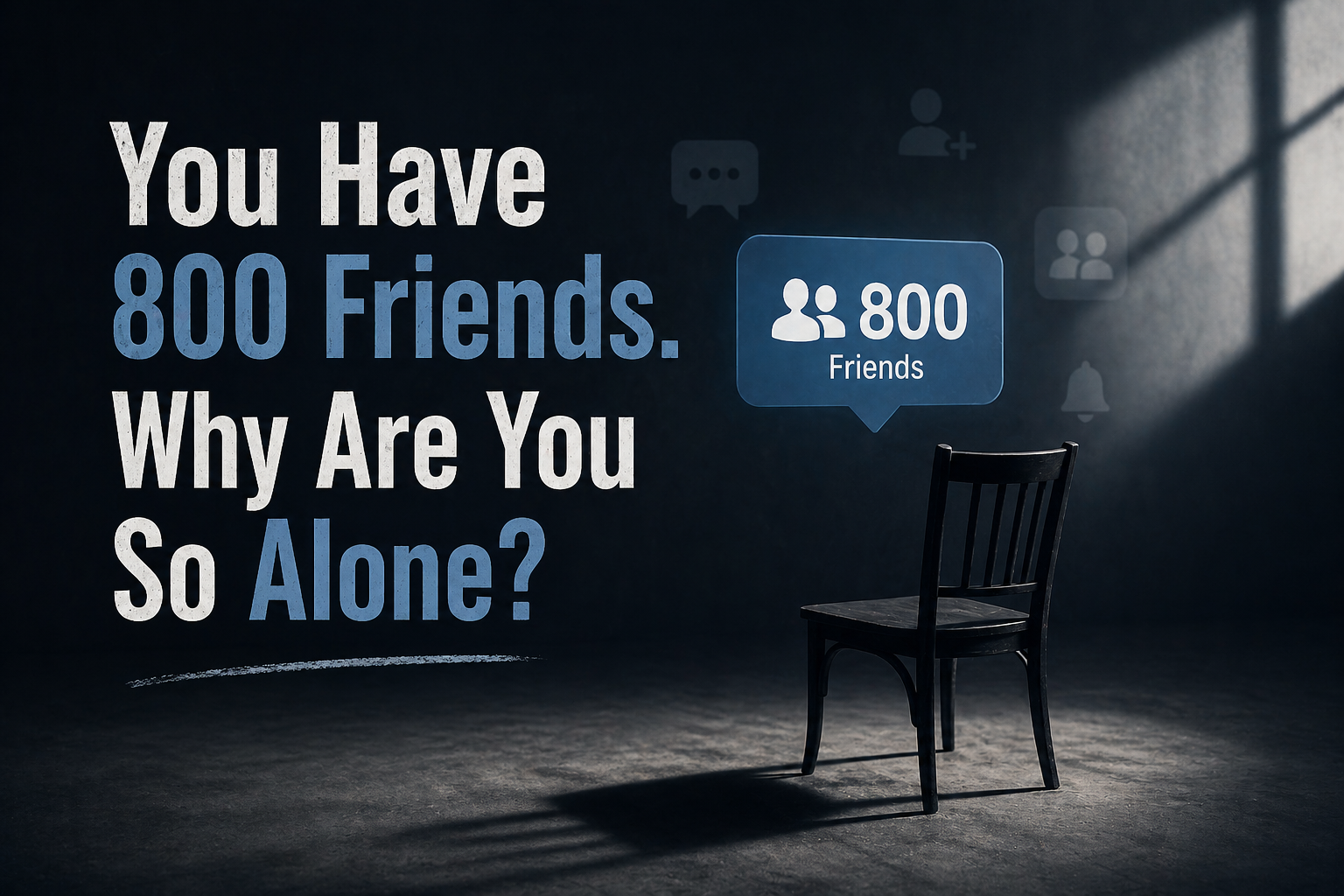
Picture a Tuesday evening. You scroll through your phone — 340 Instagram followers, a dozen WhatsApp groups, a Slack workspace buzzing with notifications. Your calendar shows lunch tomorrow and a birthday gathering on Saturday. From the outside, your life looks rich with connection. From the inside, something feels deeply, persistently wrong. You haven't had a conversation that actually mattered in longer than you can remember.
This is the paradox at the heart of the loneliness epidemic — and it is why it is so hard to treat, so easy to dismiss, and so astonishingly widespread. The U.S. Surgeon General declared loneliness a national public health crisis in 2023. The World Health Organization followed with its own global commission report in 2025. By April 2026, the data has not improved. If anything, the forces driving disconnection have deepened — and they have taken a turn that nobody fully anticipated.
A crisis hiding in plain sight
The most striking thing about loneliness is how thoroughly it defies its own stereotype. Ask most people to picture a lonely person and they will describe an elderly widow in a small apartment, a shut-in who never leaves the house. That image is not only wrong — it is precisely backwards.
According to the American Psychological Association's 2025 national survey of over 3,000 adults, more than half of Americans reported feeling isolated, left out, or lacking companionship often or some of the time. Among adults aged 18 to 34, 30% reported feeling lonely every single day or several times a week — far higher than older age groups. Gen Z reports twice the loneliness levels of Baby Boomers, and that gap is widening, not narrowing.
The most chilling number is from the WHO: loneliness is linked to an estimated 871,000 deaths annually — roughly 100 deaths every hour. For comparison, the Surgeon General noted that lacking adequate social connection carries health risks equivalent to smoking 15 cigarettes a day — and even greater risks than those associated with obesity and physical inactivity.
The medical reality
Loneliness is not a mood. It is a physiological state. Chronic loneliness elevates cortisol levels, increases inflammation, suppresses immune function, and rewires how the brain processes threat. The body experiences isolation as danger — because in evolutionary terms, it was.
What it actually does to your body
The list of conditions associated with loneliness reads like a hospital admission form. Research has consistently shown that social isolation significantly elevates the risk of dementia, heart disease, and stroke. People who are lonely are twice as likely to develop depression. Sleep deteriorates. The immune system weakens. Cognitive decline accelerates. For people in addiction recovery, social isolation is one of the most reliable predictors of relapse — a fact that has given rise to the saying in recovery circles that "the opposite of addiction is connection."
01 -> 50% higher risk of developing dementia in socially isolated adults
02 -> 29% higher risk of heart disease among the chronically lonely
03 -> 32% higher risk of stroke compared to socially connected peers
04 -> 81% of lonely adults also report suffering from anxiety or depression
05 -> $6.7 billion in extra Medicare costs annually from elderly social isolation
06 -> $154 billion in annual stress-related absence costs in the workplace
The generation that has everything and feels nothing
The counterintuitive heart of this story is Gen Z. Born between the late 1990s and early 2010s, they are the first generation for whom the internet was always there, social media was always on, and digital friendship was simply how relationships worked. They are also, by every measure available, the loneliest generation the world has ever studied.
Gen Z - ages 18 - 27 -> 73% report feeling lonely at least sometimes. 30% feel lonely every day. They are the most digitally connected humans in history.
Baby Boomers - ages 61 - 79 -> ~35% report chronic loneliness — roughly half the rate of Gen Z, despite having lived through much greater material hardship.
The Harvard study captured something words often fail to convey: 65% of lonely people feel "fundamentally separate or disconnected from others," and 57% said they were unable to share their true selves with anyone. For a generation that posts their lives publicly online, this inability to be genuinely known is a particular kind of cruelty.
Researchers point to a perfect storm: the pandemic disrupted exactly the years when adolescents develop social confidence. Remote learning removed the friction that builds resilience. And social media replaced in-person time with something that mimics connection closely enough to feel satisfying in the short term — and empty enough to leave people feeling worse in the long run.
"Nearly 3 in 5 Americans say no one truly knows them. That one statistic captures something words often fail to express: the quiet ache of feeling unseen, even in a crowd." (Cigna Loneliness in America Survey, 2025)
The AI turn — friend or trap?
In 2026, the loneliness epidemic has taken a turn that was both predictable and disturbing. As real human connection has become harder to find and maintain, millions of people — particularly young people — have begun outsourcing it to machines.
An estimated 72% of US teenagers have used AI for companionship, with the AI companion market expected to hit $435 billion by 2034. Among English 11-to-18-year-olds, 39% are already using chatbots for emotional support, with 21% saying it is easier to talk to AI than to a real person. One-third of teens already prefer AI companions over humans for serious conversations, according to a 2025 survey by Common Sense Media.
The AI companionship paradox
The Appeal -> Always available. Never judges. Never gets tired. Never cancels plans. Perfectly validating.
The Risk -> Mirrors back what you want to hear. Creates a "loneliness loop." Stunts social development at critical age.
Researchers at the University of Manchester warn that AI chatbots are "compelling, personable, and never irritable or jealous" — but that these very qualities make them particularly dangerous for young people still learning how to handle conflict, rejection, and the productive friction of real relationships.
The concern voiced most urgently by psychologists is not that AI companions exist — it is what happens when they replace, rather than supplement, human connection during the years when social skills are formed. Using AI to draft messages to friends creates an "expectation mismatch" — the recipient is responding to an AI-polished version of their friend, not the actual person. Over time, this erodes confidence in one's own voice, limits the ability to read social cues, and prevents the kind of authentic self-expression that meaningful relationships require.
The cruel irony is that AI companions are designed to be maximally agreeable — and it is precisely this quality that makes them poor substitutes for real relationships. Relationships should be messy, and that friction is part of what makes people more socially competent in the long run. A friend who never pushes back is not really a friend. It is a mirror.
What actually works
The good news — and there is some — is that loneliness is not a permanent condition. It is responsive to intervention. The 2025 World Health Assembly passed its first-ever resolution on social connection. The WHO launched a global "Knot Alone" campaign. And 2026 insurance reforms have improved access to cognitive behavioral therapy, which has strong evidence for treating the thought patterns that reinforce isolation.
01 -> Invest in physical infrastructure
Three-quarters of lonely Americans say they want more accessible public spaces, green areas, and community events. Libraries, parks, and third places are not luxuries — they are loneliness medicine.
02 -> Make it a medical conversation
The Surgeon General has called on physicians to ask about loneliness as routinely as they ask about smoking or diet. Most doctors never raise it. That needs to change — the data demands it.
03 -> Reach out, even when it feels awkward
Research consistently shows people overestimate how burdensome their outreach will feel to others. Most of the time, the person on the other end is relieved and grateful someone called.
04 -> Use AI tools wisely — not as replacements
The WHO acknowledges blended approaches — digital tools combined with human guidance — can reduce loneliness for hard-to-reach groups. The key word is "combined." Technology can open doors. Only people can walk through them.
05 -> Address the cost-of-living link
Americans earning under $30,000 per year are the loneliest demographic. Loneliness is not just a feelings problem — it is an economic one. Policies that reduce financial stress free people to invest in their social lives.
The bottom line
The loneliness epidemic is real, it is deadly, and it is accelerating in exactly the directions that should concern us most — towards the young, the digitally connected, and the professionally successful. It is killing people as surely as cigarettes and with far less public attention. But it is also — and this matters — reversible. It responds to time, to presence, to the willingness to be known and to know others in return. The tools to fix it are not complicated. They are ancient. In the age of AI companions, 5G networks, and algorithmically curated social feeds, the most radical act available to any of us might simply be this: put the phone down. Call someone. Mean it.