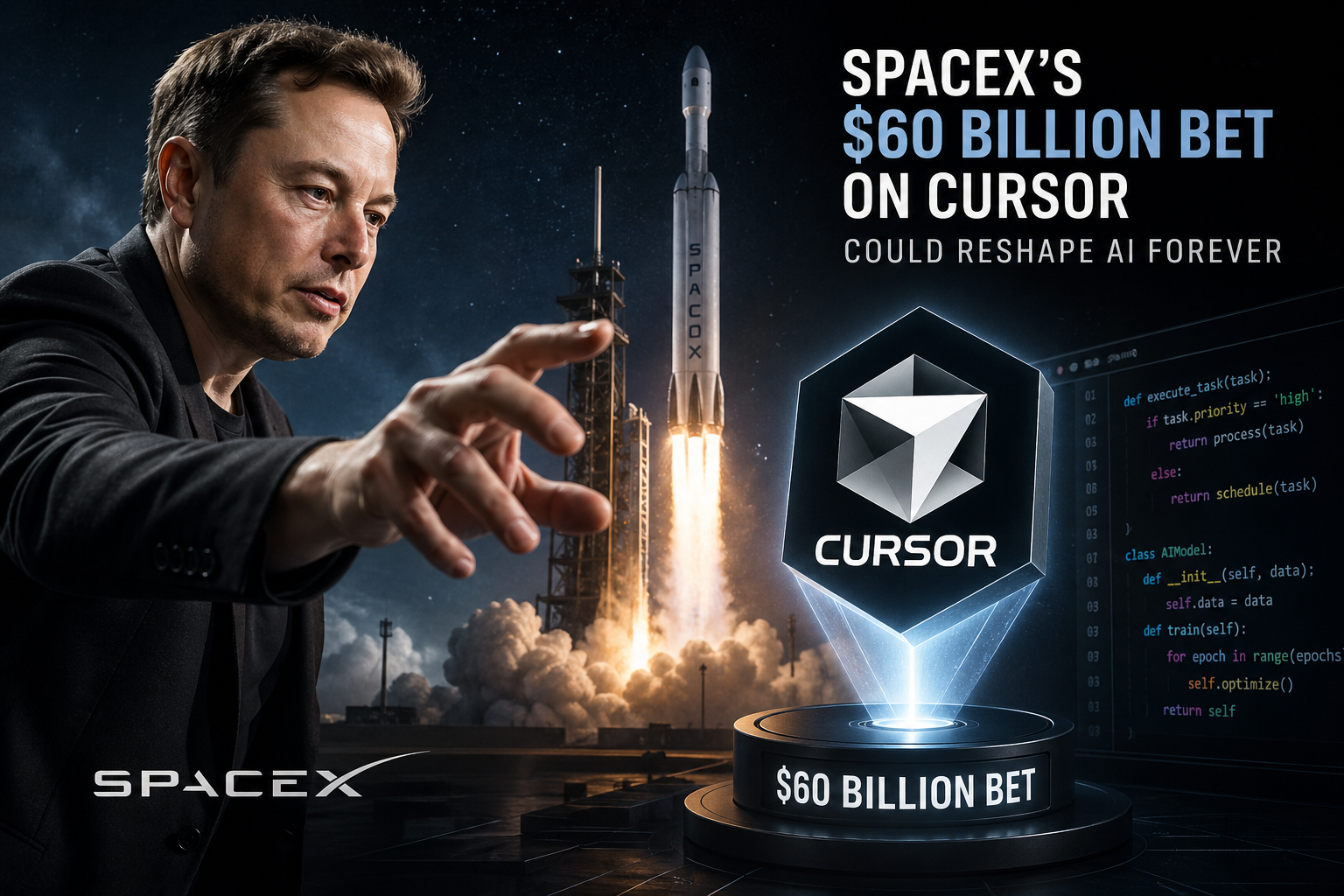
In Silicon Valley, where billion-dollar deals have become almost routine, SpaceX just did something that made the entire tech industry stop and stare. On April 22, 2026, Elon Musk's rocket company announced it had struck a partnership deal with Cursor — the fastest-growing AI coding tool in history — and quietly slipped in a bombshell clause: SpaceX now holds the option to buy the startup outright for $60 billion later this year.
If exercised, it would be one of the largest acquisitions in tech history. And it would hand Musk a weapon in the AI wars he has so far been missing: a product that developers actually love.
From Rockets to Code: What Is Cursor?
Cursor isn't just another chatbot layered on top of a text editor. Built by Anysphere — a San Francisco startup founded in 2022 by four MIT students — Cursor is an AI-native integrated development environment (IDE). It watches you code, predicts what you'll type next, and increasingly can write entire programs autonomously with just a broad prompt from the user.
The numbers behind its rise are almost absurd. In January 2025, Cursor was valued at $2.5 billion. By May, it was $9 billion. By November, it closed a $2.3 billion Series D that put its post-money valuation at $29.3 billion. And just before this deal was announced, it was in talks to raise at a $50 billion valuation — a trajectory that has left competitors breathless.
Who built Cursor?
Cursor was co-founded by 25-year-old Michael Truell alongside MIT classmates Aman Sanger, Arvid Lunnemark, and Sualeh Asif — a Pakistani co-founder whose involvement has made this deal a source of national pride in Pakistan. The team dropped out of MIT to pursue the project, obsessed with the future of AI-assisted development. Truell is now reportedly worth an estimated $1.3 billion.
The Deal, Decoded
The agreement has two paths. SpaceX can acquire Cursor entirely for $60 billion at some point before the end of 2026. Or, if it chooses not to pull the trigger, it will pay Cursor $10 billion for the collaborative work they're doing together — specifically, building what the company described as "the world's best coding and knowledge work AI."
Central to this collaboration is SpaceX's Colossus supercomputer — a colossal training cluster equivalent to one million H100 GPUs. Pairing Cursor's software expertise and its massive developer user base with that kind of raw compute power is a combination neither company could achieve alone.
"The combination of Cursor's leading product and distribution to expert software engineers with SpaceX's Colossus training supercomputer will allow us to build the world's most useful models." (SpaceX, official announcement, April 2026)
Why Now? The Race Musk Is Losing
Context matters here. In February 2026, Musk merged SpaceX with his AI startup xAI — in a deal he valued at $1.25 trillion — and is now preparing to take the combined company public in what analysts expect to be a record-breaking IPO. To justify that valuation, SpaceX needs credible AI products. And right now, by most accounts, xAI's models trail the leading offerings from Anthropic and OpenAI — the same companies that compete directly with Cursor for developer mindshare.
The timing of Tuesday's announcement was also conspicuous: it landed just days before the start of the high-profile Musk v. Altman lawsuit, pitting SpaceX's founder against OpenAI CEO Sam Altman, whose company was an early investor in Cursor itself. The deal is partly a strategic signal — Musk is coming for OpenAI's territory.
Microsoft Was Also in the Room
SpaceX wasn't the only suitor. According to sources cited by CNBC, Microsoft — the company that invested billions in OpenAI and owns GitHub Copilot, Cursor's closest competitor — had also explored acquiring Cursor before SpaceX moved in. That Microsoft walked away (or was outmaneuvered) says something about the speed and ambition of this deal.
What It Means for the Future of Coding
If this acquisition goes through, the implications ripple far beyond corporate finance. Cursor already powers coding at 67% of Fortune 500 companies, including Salesforce, Samsung, and Budweiser. An acquisition by SpaceX — now a sprawling tech conglomerate stretching from orbital rockets to social media to AI — would give Musk extraordinary leverage over the infrastructure of software development itself.
Developers would, in effect, be coding inside a platform owned by Elon Musk, trained on SpaceX's supercomputers, integrated into the xAI ecosystem. For some, that's a dream. For others, it raises serious questions about concentration of power in an industry that has always prized its independence.
The competitive landscape
Cursor's main rivals include GitHub Copilot (owned by Microsoft), OpenAI's Codex, and Anthropic's Claude Code — which launched just over a year ago and has already gained significant traction among professional programmers. All three are now watching this deal very closely.
The Decision Ahead
For Cursor CEO Michael Truell — 25 years old, a college dropout, now sitting across the table from one of the most powerful figures in tech — the months ahead will define his legacy. He has described the partnership as "a meaningful step on our path to build the best place to code with AI." Whether SpaceX ultimately writes the $60 billion check, or whether the partnership ends at $10 billion, is a decision that could reshape the competitive map of artificial intelligence.
One thing is already certain: the race to own the future of how humans write software just got a great deal more interesting.